

The 8 Universal Principles of Customer Problems in B2B SaaS
Understanding the true nature of all customer needs reveals how you can create solutions that deliver exceptional value, and why common misconceptions lead to feature-bloated products.

💡 This is part #3 in an article series that introduces a better way to create B2B SaaS products, starting from the first principles. To get the most out of the series, read the intro article #1 and part #2 first, and then subscribe to keep following along!
In my previous article, I posed a provocative question, without answering it:
What is a “customer problem”, to which a software product is a “solution” – in principle?
The answer to this question is the cornerstone of creating winning B2B software products. Yet this question seems to elude much of the software industry.
I argued that a customer problem must not be defined in terms of any solution, so it cannot be:
The pain points in a solution that customers complain about
The lack of a solution (that’s circular logic)
The features that customers request (they are solutions)
Misunderstanding customer problems turns promising product companies into feature factories. Backlogs overflow with feature requests, customer complaints, and ideas, while the prospect of an elegant, scalable, market-winning product slips further away.
There is a way out. Before we get to it, we need to lay some groundwork. We will start with something deceptively simple: a cup of tea. By stripping away complexity, we can uncover the principles that govern all customer problems, from everyday tasks to the operations of large enterprises.
What is the best solution for boiling water?
Consider five ways to boil water:
Kettle
Microwave oven
Electric stove
Trangia stove (a portable stove that uses alcohol as fuel)
Campfire

Which is the best solution for boiling water to make tea? Three scenarios illustrate the answer.
A) Alice’s evening ritual: Winding down at home
Imagine Alice at home, exhausted after a long day, and getting ready to go to bed soon. To relax, she enjoys having a cup of tea. Which solution suits her best?
Going outdoors at night to make a campfire makes no sense. Digging out her Trangia from the closet and messing with fuel is equally impractical. The electric stove in her kitchen is more sensible, but slow at heating water. A microwave is faster but awkward: how long until the water is boiling hot without boiling over? And microwaves heat unevenly, with the water at the top boiling before the water at the bottom. Its benefit is that she can pour the right amount of cold water directly into the tea cup, and heat the water there.
Her electric kettle is the clear winner: it sits ready on the counter, it fills and starts easily, it heats water quickly and evenly through convection, it switches off automatically when the water boils, she is unlikely to burn herself, and it is the most energy-efficient option.
B) Bob’s wilderness challenge: Hydration on the hike
Bob is trekking through remote wilderness. A cup of tea helps him stay warm and hydrated, since boiling makes the water safe to drink. Which solution is the best for him?
Anything electric is out of the question. A campfire takes real effort: finding dry wood, locating a suitable spot, lighting the fire, and rigging something to hold a pot over it. His Trangia stove is the right answer: lightweight, designed for backpacking, and manageable in primitive conditions.
C) Carol’s family adventure: Forest fun with the kids
Carol is out in the forest on a Sunday afternoon with her children. The goal is to give them a new experience.
Unlike Bob, she has no need for convenience. Every step of making a campfire, from gathering wood to getting the water boiling, is an exciting and educational adventure for the children. Once the fire is going, maybe they will grill a few sausages, too.
The 8 universal principles of all customer problems
This tea-making example reveals a great deal about the nature of customer problems. Here is what the three situations tell us about problems, solutions, and the relationship between them.
Principle 1: Customer problem is a specific situation of a particular customer
“Boiling water for tea” is at the core of these situations. It is what each person is trying to accomplish.
But what a customer is trying to get done is not enough to define a customer problem. Alice, Bob and Carol benefit from different solutions, which means the nature of their problems is necessarily different. The difference lies in their situations.
A customer problem must be described as a specific situation of a particular customer. Beyond the basic need to “boil water to make tea”, a customer problem specifies who the customer is, where they are, when, and what their motive is, among other aspects of the situation.
Principle 2: Customer problem is independent of solutions
A customer problem, properly understood, exists in the world independently of any past, present or future solutions. The descriptions of Alice’s, Bob’s and Carol’s customer problems illustrate this: none of them mention anything about possible solutions to boil water. They describe the situations only.
Principle 3: One customer problem, multiple solutions
There are different, competing solutions to the same customer problem, and more can be invented. Some of the solutions are simply better than others for a given situation.
Principle 4: Different solutions to the same problem can be compared objectively
Given a specific customer problem, we can compare alternative solutions relatively objectively. We do this by analysing all the actions the customer must take in each situation to reach the desired end-result (hot water for tea), and the quality of that result.
Objective comparison does not require empirical tests, such as having a target user actually light a campfire. It only requires a detailed understanding of the situation and how each solution functions within it.
Principle 5: For a different customer problem, a different solution is best
Since we can compare alternative solutions for each customer problem, we can also determine which is the best among the available alternatives. If a customer problem is different enough, a different solution is optimal, as Alice’s, Bob’s and Carol’s situations show.
Principle 6: There is no universally best solution
There is no universally best solution for the customer problem of “boiling water”. Why not?
Because “boiling water” is too generic a description of a customer problem. Generic situations do not exist in the real world. In reality, a particular customer is always in a specific situation.
To evaluate alternative solutions to any customer problem, we must examine all the actions a real person needs to take with a solution and the result they can achieve. That analysis is impossible without a specific situation, because the situation determines how each solution can be used in it, if at all.
The quality of a solution is thus a matter of fit between it and a particular customer problem. Problem-solution fit depends on both the problem and the solution.
Principle 7: Customer problem represents a class of essentially similar situations
A customer problem represents many similar situations across different customers, even though it is described as a single specific case.
Every real situation is unique to a specific person, time, place, and circumstances, but most of these differences do not matter when evaluating solutions. For example:
Alice’s age does not change the customer problem. Personal characteristics often have little or no impact. (Except if Alice is a frail senior with arthritis.)
The country where Bob is hiking is irrelevant: Canada or Norway, the situation is the same. (Saudi Arabia might be different.)
Whether Carol has two or three children does not change the customer problem. (Ten kids might.)
Alice’s, Bob’s, and Carol’s situations are not the only customer problems related to boiling water for tea. Someone performing a Japanese tea ceremony faces a very different customer problem: the motive and the situation are entirely different.
How do we identify which details about a customer and their situation actually matter? That is an in-depth topic I will return to in a future article. Subscribe now to receive it when I publish it.
Principle 8: Customer problems change slowly, solutions change fast
Customer problems generally change quite slowly. Solutions change as fast as humans can imagine and develop them.
Alice’s situation has existed for hundreds of years, while solutions have evolved considerably. Humans have boiled water over fire for millennia; Trangia stoves and microwave ovens arrived in the 1950s.
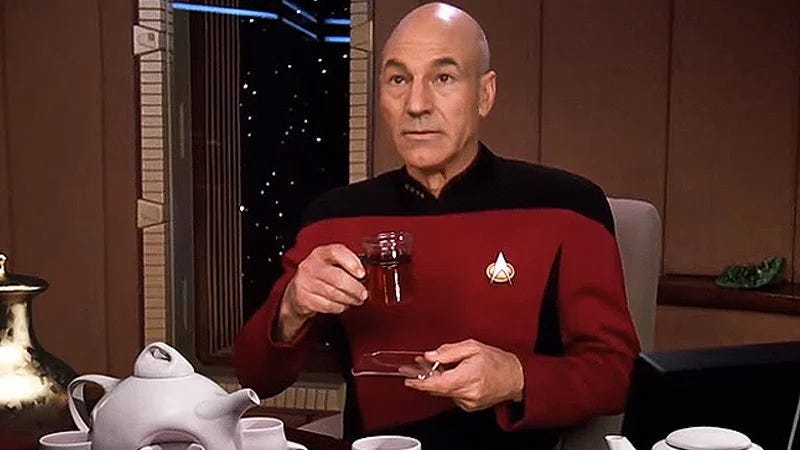
Alice’s customer problem is likely to remain largely unchanged for centuries. Consider the tea-drinking Captain Picard of Star Trek set in the 2300s. His customer problem is the same as Alice’s. His solution, however, is rather better: “Tea, Earl Gray, hot.” Immediately, a cup materialises in the food replicator that reconstitutes matter out of pure energy.
Summary of customer problems vs. solutions
The figure below summarises the relationship between customer problems and solutions
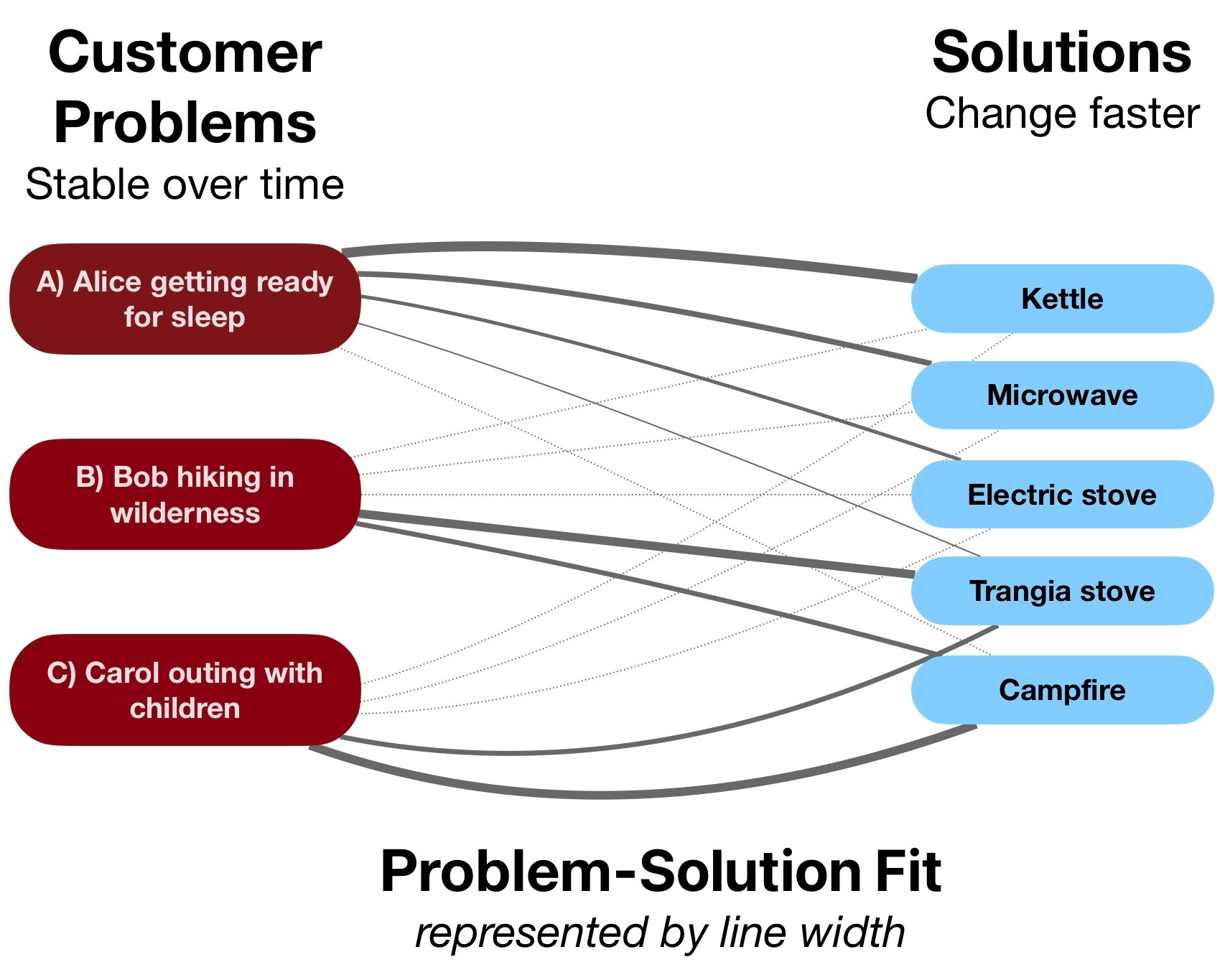
Customer problems are independent of solutions.
Each customer problem has many possible alternative solutions.
Different solutions fit each customer problem better or worse.
For each customer problem, there is a best solution.
There is no universally best solution.
The quality of a solution is a matter of problem-solution fit.
Problem-solution fit can be evaluated objectively.
Customer problems are stable over time.
Solutions may change much faster than customer problems.
From tea to tech: Why this matters for your B2B product?
You might be thinking: this is interesting, but I am building enterprise software, not brewing tea.
The same principles apply. B2B software products are solutions to customer problems. The fit between a product and the customer problems it addresses determines how well it sells and how much customers value it. A product built on a vague or solution-contaminated understanding of customer problems will always struggle, however polished the interface or sophisticated the technology.
The practical power of these principles becomes clear when you apply them to complex business operations. In the next article, I will work through the shared structure of customer problems in detail, which apply from something as simple as brewing tea to situations like:
Operating a bustling hospital
Managing a reinsurance business
Inspecting nuclear plant safety
Planning airport logistics
Each of these, despite obvious differences, shares structural elements with Alice’s evening cup of tea. Once you can see those elements clearly, product discovery and product design of B2B software become considerably more tractable.
Subscribe now to get the next article when it comes out.
Continue reading part #4 of the series: How to Define Customer Problems That Lead to Innovative B2B SaaS Products and master the 10 essential elements of customer problems your competitors probably miss!
How to Define Customer Problems That Lead to Innovative B2B SaaS Products

Master the 10 essential elements of all customer needs that your competitors probably miss. In this article, you will learn:
* The non-negotiable test for understanding customer needs correctly
* Why common customer problem definitions doom a product from day one
* The 10 essential elements of every customer problem you need to understand
* Why understanding these elements gives you an unfair advantage